Hobbies Issue 6
How to Play Liar's Dice: Bids, Challenges and Simple Odds
- Filed on
- Read in
- 4′
- Entry
- 65
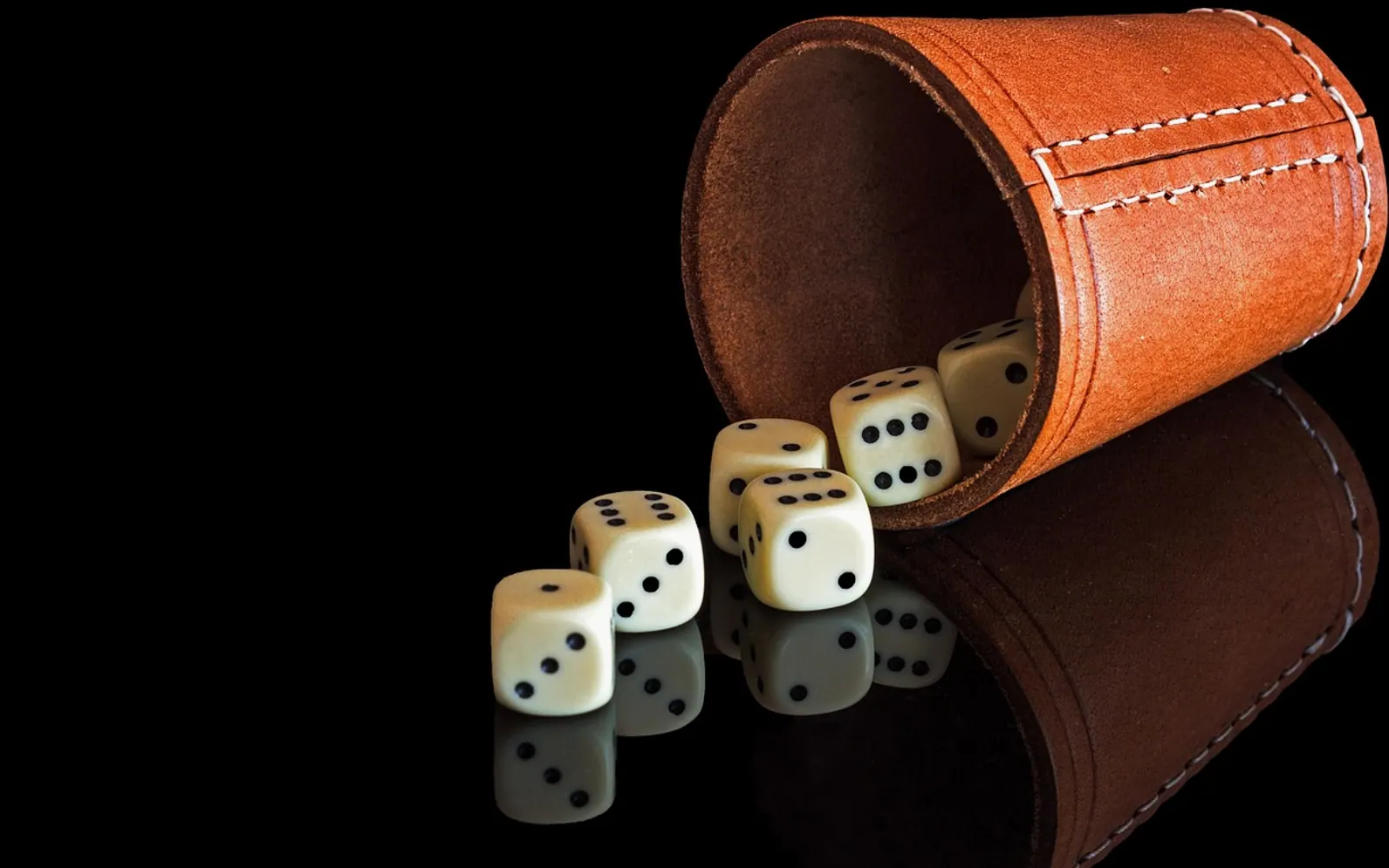
Liar's Dice is a bluffing game for two to six players. Everyone shakes five dice under a cup, checks their own roll in secret, and then players take turns bidding on how many dice of a certain face are showing across the whole table. Each bid must top the previous one, until somebody refuses to believe it and calls "liar". The cups come up, and whoever was wrong loses a die. Lose all five and you are out; the last player holding dice wins.
Equipment
- Five dice for each player
- One opaque cup per player (paper cups are fine)
- A table where everyone can see the reveals
The rules, step by step
- Shake and peek. Everyone shakes their cup, sets it face down, then tilts the edge to check their own dice without showing anyone.
- Open the bidding. The starting player bids a quantity and a face, such as "four 3s". That claims at least four dice showing 3 among all the dice on the table, not only in the bidder's cup.
- Raise or challenge. The next player either raises or calls. A raise must increase the quantity ("five 2s" beats "four 3s") or keep the quantity and name a higher face ("four 5s" beats "four 3s").
- Reveal. On a challenge, every cup is lifted and the named face is counted. If the count reaches the bid, the challenger loses a die. If it falls short, the bidder loses one.
- Next round. The player who lost a die usually opens the following round, and everyone re-rolls whatever dice they still have.
The wild-ones variant
Many groups treat 1s as wild, counting toward any face. A bid of "six 4s" is then satisfied by any mix of 4s and 1s. Because wilds make every face more common, bids climb faster.
With wild ones, bidding on the 1s themselves needs a special rule. A common version lets a player switch to 1s by halving the quantity (rounded up), and switch back from 1s by doubling it and adding one. After "seven 5s", for example, a player may bid "four 1s"; after "four 1s", the next player needs at least nine of another face.
The exact call
An optional rule lets a player say "spot on" instead of "liar", claiming the bid is exactly right. If the count matches precisely, the caller either wins back a lost die or every other player loses one, depending on house rules. If it misses in either direction, the caller loses a die.
Judging a bid with a quick expected count
Liar's Dice rewards a rough feel for probability. Every unseen die has a 1-in-6 chance of showing a particular face, or 1 in 3 when ones are wild, since both the face and the wild 1 count. So a fair estimate for any face is:
- the matching dice in your own cup, plus
- the number of unseen dice divided by 6 (or by 3 with wild ones).
| Four players, 20 dice | Your cup | Unseen dice | Expected number of 4s |
|---|---|---|---|
| No wilds | two 4s | 15 | 2 + 15 ÷ 6 = about 4.5 |
| Ones wild | two 4s and a 1 | 15 | 3 + 15 ÷ 3 = 8 |
An expected count is an average, not a promise; real totals scatter around it. Still, a bid well above the estimate is a fair target for a challenge, and one well below it is usually safe to raise. The same counting logic sits behind the probabilities of two-dice totals.
Bluffing and table habits
- Mix up your bids. Always bidding the face you hold makes you easy to read. Now and then naming a face you lack can tempt an opponent into a raise they cannot support.
- Watch who pushes what. A player who keeps raising one face probably holds several of it.
- Raise in small steps. Jumping the quantity by three tends to trap the bidder rather than the next player.
- Tighten up late. With only a handful of dice left on the table, a single die swings everything, and cautious bids hold up more often.
Common rule questions
Can you raise the face and lower the quantity?
No. Apart from the wild-ones conversion, the quantity never goes down.
What happens if a die lands off the table?
Roll it again under the cup before any bids are made.
How does it differ from other dice games?
Most dice games are about what you roll. Liar's Dice is about what the others believe you rolled, which puts it closer to a card-table bluff than to Farkle's push-your-luck turns. Groups that enjoy reading opponents tend to like a hand of gin rummy as well.
The game works perfectly with nothing riding on it but pride. Adults who decide to add a small wager should keep it trivial, stop the moment it stops being fun, and know the local position on playing for money at home.
Editor’s picks
 HobbiesFarkle Rules and Scoring: How the Six-Dice Game Works4 min
 GamblingThe Craps Odds Bet Explained: True-Odds Payouts Behind the Line4 min
 GamblingWhat Is the House Edge? The Built-In Margin, Explained4 min
 BlogWHAT I ACTUALLY DO FOR A LIVING | BUILT 11 INCOME STREAMS BY AGE 27 | Side Hustles & Passive Income2 min