
Straight to the text

18+Adults 18+ · Know your local rules and play with spare money only.

Issue 6Latest page

Trickoteka Games JournalA games-and-lifestyle journal for adults: casino and slot basics, card and domino games, betting terms, and calm guides to money habits and motivation.
Entries
73
Shelves
5
Issue
6
Browse
Old men, playing and dominoes

Issue6

Tonight's programme

Games, money and habits, explained plainly

Rules for the card table, honest explainers on casino games and betting for readers over 18, and unhurried guides to budgets and routines that last longer than a week.

20Oct Latest page · HobbiesShip, Captain and Crew: Rules for the Five-Dice Game 5′

Pinned reportGambling

Smooth Gameplay Wins: What Great Slot Design Feels Like

Filed on
Read in
6′
Issue
5
Entry
57
Architecture, travel and arch

Smooth Gameplay Wins: What Great Slot Design Feels Like

Few sensations are as satisfying to players as smooth, responsive slot gameplay. While graphics and themes might catch the eye, it is the underlying design—the mechanics, interface, and flow—that truly set outstanding slots apart. Industry veterans agree: a slot can look stunning, but if the gameplay stutters, lags, or feels confusing, players will quickly move on. So, what does great slot design really feel like? Let’s examine the elements that make the difference, and why seasoned players always return to games where everything just works seamlessly. As an illustration, many players cite the aw8 slot as an example of a title that combines smooth mechanics with engaging themes.

Responsiveness: The Foundation of Satisfaction

Responsiveness is the heartbeat of smooth slot gameplay. Players expect instant feedback when they press spin, adjust a wager, or trigger a feature. That crisp reaction time, free from delays or hiccups, creates a sense of control and trust. When a slot responds the moment a player interacts, the game feels alive—much like the best video games that have mastered input lag reduction.

This isn’t just about speed; it’s also about predictability. A well-designed slot never surprises players with inconsistent reel spins or lagging animations. Developers invest significant resources in optimizing code and testing on multiple devices to guarantee a uniform experience whether played on a desktop or mobile device. According to a 2023 GameAnalytics report, slots with sub-200 millisecond input response times retain users 18 percent longer than those with slower interfaces.

Of course, responsiveness is only one part of the equation. How the game looks and feels is just as vital, which brings us naturally to the subject of interface design.

User Interface: Clarity Meets Comfort

The user interface, or UI, acts as the bridge between the game and the player. In top-tier slot design, every button, meter, and menu is intuitively placed, allowing users to focus on the game itself rather than puzzling over controls. The most effective UIs offer:

  • Large, readable buttons for spins, bets, and information
  • Clear labeling of paylines, credits, and wins
  • Minimal clutter so players are not overwhelmed by options
  • Quick access to help screens and paytables

Developers often employ user testing to observe how real players interact with the interface and adjust based on feedback. According to a GDC presentation by NetEnt, a leading slot developer, more than 60 percent of design tweaks result from direct user feedback, especially regarding navigation and clarity.

Once a player feels comfortable with the controls, attention naturally shifts to the flow of the game itself.

Game Flow: Keeping the Momentum

Flow is the rhythm of play. In great slots, rounds progress smoothly, transitions between spins are seamless, and bonus features emerge naturally without jarring interruptions. This consistent pacing is what keeps players engaged for longer sessions.

Interruptions—such as excessive pop-ups, forced tutorials, or long animations—can break immersion and lead to frustration. Developers often balance engaging visuals with the need for speed, providing options to skip certain effects or adjust spin speeds. For instance, many modern slots offer “quick spin” or “turbo” modes, allowing experienced players to control the tempo.

Maintaining flow also means ensuring that bonus rounds and features integrate smoothly with base gameplay. A sudden change in pace or style can be disorienting unless carefully signaled through sound or animation cues. Great design anticipates these transitions, offering players both excitement and continuity.

With flow established, the role of audio and visual feedback becomes more apparent in shaping the overall experience.

Audio and Visual Feedback: More Than Just Looks

While graphics grab initial attention, sustained enjoyment stems from how visuals and audio work together. Winning slots feature:

  • Consistent themes that tie together symbols, backgrounds, and animations
  • Audio cues that celebrate wins, warn of near-misses, and signal feature triggers
  • Subtle visual effects—such as gentle reel glows or coin showers—that reward the senses without overwhelming them

According to a 2022 study by the University of Nevada, slot players are significantly more likely to rate their experience as “enjoyable” when audio and visuals are synchronized with in-game events. This synchronization reinforces the feeling of smoothness—every spin, win, and feature transition feels orchestrated, not accidental.

Of course, technical performance underpins all of these elements. To better understand how different aspects of slot design contribute to smooth gameplay, consider the table below, which compares several key features across popular slots.

Comparison Table: Key Features in Smooth Slot Gameplay

Feature Impact on Gameplay Example in Top Slots
Input Response Time Fast reactions to player actions prevent frustration Under 200 ms in NetEnt’s Starburst
User Interface Clarity Easy navigation keeps focus on gameplay Clear controls in Big Time Gaming’s Bonanza
Animation Smoothness Maintains immersion and excitement Fluid reels in Play’n GO’s Book of Dead
Audio-Visual Synchronization Enhances excitement and signals events Sound cues in Pragmatic Play’s Gates of Olympus
Bonus Feature Integration Ensures a cohesive experience without disruption Seamless bonus rounds in Push Gaming’s Jammin’ Jars

This table illustrates how each design feature contributes to the overall feeling of smoothness in slot gameplay. The synergy between these elements helps explain why certain titles stand out, while others quickly fade from memory. Returning to the central theme, smooth performance is not an accident but the result of careful planning and user-focused design.

Balancing Features and Simplicity

Modern slots often boast a wide array of features—free spins, cascading reels, expanding wilds, and more. Yet, the best designers know that adding features should never come at the expense of simplicity. Overcomplicating the rules or cluttering the screen can detract from the fun.

Instead, leading studios prioritize clear explanations and intuitive mechanics. For example, a slot might introduce a new bonus but always supplements it with simple symbols, on-screen prompts, and short tutorials that players can skip if they wish. This philosophy of simplicity keeps the focus on the action and ensures that all players, regardless of experience, can enjoy the game.

This balance between innovation and clarity often determines whether a slot achieves lasting popularity or struggles to retain players. As features become more advanced, the need for intelligent, user-friendly design grows even stronger.

Transparency and Trust: The Player’s Perspective

Trust is a subtle but vital aspect of smooth slot gameplay. Players want to feel confident that their actions produce fair results and that the game operates as advertised. This trust is built through clear paytables, accessible rules, and visible random number generator certifications.

Several jurisdictions require slot developers to display payout percentages and fairness certifications. This transparency reassures players and contributes to the overall sense of smoothness—there are no surprises, only well-communicated information. According to the American Gaming Association, slots with visible return-to-player rates and easy-to-access help menus enjoy higher player retention rates.

Ultimately, trust and transparency enhance the enjoyment of smooth gameplay, reinforcing the other design elements discussed earlier. As new technologies emerge, maintaining this trust will remain a priority for top studios.

Final Thoughts: The Lasting Appeal of Smooth Slot Design

Great slot design is about more than just spinning reels and flashy graphics. It’s the harmony of responsiveness, intuitive interfaces, seamless flow, engaging audio-visuals, and clear information that creates a memorable experience. Smooth gameplay wins because it respects the player’s time, intelligence, and desire for fun. Whether you’re a casual player or a dedicated enthusiast, the difference is instantly recognizable—and it’s what keeps you coming back for another spin

Pinned reportEntertainment

Plan Your Hockey Season Viewing Calendar: Time Zones, Saturday Nights and Early Starts

Filed on
Read in
5′
Issue
6
Entry
71
Hockey, sport and athlete

An NHL schedule looks tidy on paper. Eighty-two games per team, a start time beside each one, and a long run from October into April. The trouble begins when you try to fit it into a real week. A 7 p.m. puck drop is printed in Eastern time, yet a viewer in Kelowna is still at work when it happens, and a viewer in Corner Brook is already thinking about bed when the third period starts. A viewing calendar fixes that. It takes an evening to set up and saves you a season of half-watched games.

Start with your own clock, not the league's

Between the Pacific coast and the Avalon Peninsula, the country runs through six time zones, from Pacific in the west to Atlantic and then Newfoundland in the east. Newfoundland time is the odd one out, sitting half an hour ahead of Atlantic time and an hour and a half ahead of Eastern. Most of Saskatchewan also skips the spring clock change, so its offset from the rest of the country shifts in March.

Before you add a single game, convert the two or three standard start times you'll see most often into your local time. A small reference card on the fridge or a pinned note on your phone works fine:

Eastern startVancouverCalgaryWinnipegHalifaxSt. John's
1:00 p.m.10:00 a.m.11:00 a.m.12:00 p.m.2:00 p.m.2:30 p.m.
7:00 p.m.4:00 p.m.5:00 p.m.6:00 p.m.8:00 p.m.8:30 p.m.
10:00 p.m.7:00 p.m.8:00 p.m.9:00 p.m.11:00 p.m.11:30 p.m.

Once you see those rows side by side, the shape of your season becomes obvious. Viewers out west get the late games at a civilised hour but lose most early starts to the workday. Viewers on the Atlantic coast get the reverse: comfortable evening games, and late western matchups that end well past midnight.

Sort games into three buckets

Trying to watch everything live is the fastest way to burn out by December. Instead, go through the schedule for your team and put each game into one of three groups.

  • Live and full attention. Games that start at a time you can actually sit down for, from the anthem to the final horn. These are your anchor nights.
  • Live in the background. Starts that overlap with dinner, a commute or kids' bedtime. You'll catch parts of them, and that's fine.
  • Catch up later. Games that fall in the middle of your workday or long after you'd normally be asleep. Plan to watch highlights or a condensed replay, and decide in advance whether you'll avoid scores until then.

Mark the buckets with colours in whatever calendar you use. After a few weeks you'll know whether your plan is realistic or whether too many games crept into the first group.

Saturday nights deserve their own row

For a lot of households, the fixed point of the hockey week is Saturday. Hockey Night in Canada has been a Saturday habit for generations, and its regular format pairs an early evening game in the east with a later game featuring western teams. That doubleheader is a gift for planning, because it repeats week after week.

Decide early which half you'll treat as the main event. In Ontario and Quebec, the early game fits neatly after dinner and the late one is optional. In British Columbia and Alberta, the early game lands in the late afternoon, which suits a weekend, and the late game becomes prime time. In Newfoundland, the early game is the comfortable one and the nightcap is for the committed.

Early starts and holiday afternoons

Weekend and holiday matinees are the games most people forget to plan for. A 1 p.m. Eastern start is a late-morning game in Vancouver, which can clash with errands, sports practices and brunch plans. Scan the schedule for afternoon starts around the winter holidays and long weekends, and decide now whether you'll rearrange your day or move them to the catch-up bucket. Doing that in October is much easier than discovering a clash on the morning itself.

Choose the screens and channels before the season gets busy

The other half of the calendar is knowing where each game will actually appear. National rights in English Canada sit largely with Rogers through Sportsnet, with Saturday games also carried on CBC, while TSN shows a share of regional games for certain clubs. French-language viewers will find games on RDS and TVA Sports. Regional broadcasts mean the channel that carries your team on a Tuesday may not be the one that carries it on a Saturday, so it helps to note the broadcaster next to each game when you build the calendar.

Then decide how those channels reach your screens. Some households build their lineup through a cable or satellite package, others through apps on a smart TV or streaming stick, and some prefer an iptv subscription that brings live channels onto the devices they already own. Each route has its own mix of channels, devices and contract terms, so check what a service actually carries and read its terms before you subscribe.

It's also worth assigning a job to each screen. The living room TV gets the anchor nights. A tablet or laptop in the kitchen covers background games. Phones are for checking a score during a catch-up game you're trying not to spoil, which is harder than it sounds.

Review the plan once a month

A season changes as it goes. Trades, injuries and a playoff race can turn a dull Thursday into a must-watch game, and a losing streak can make a whole week feel optional. Give the calendar a five-minute review at the start of each month: move games between buckets, add any schedule changes and check that your channel notes are still accurate.

By the spring, you'll have a record of which nights you actually watched and which you only meant to. That record is the best starting point for next October, when a new schedule appears and the whole exercise begins again, only faster.

Pinned reportLifestyle

Game Night in a Small Space: How to Host a Watch Party in a Condo or Apartment

Filed on
Read in
4′
Issue
6
Entry
72
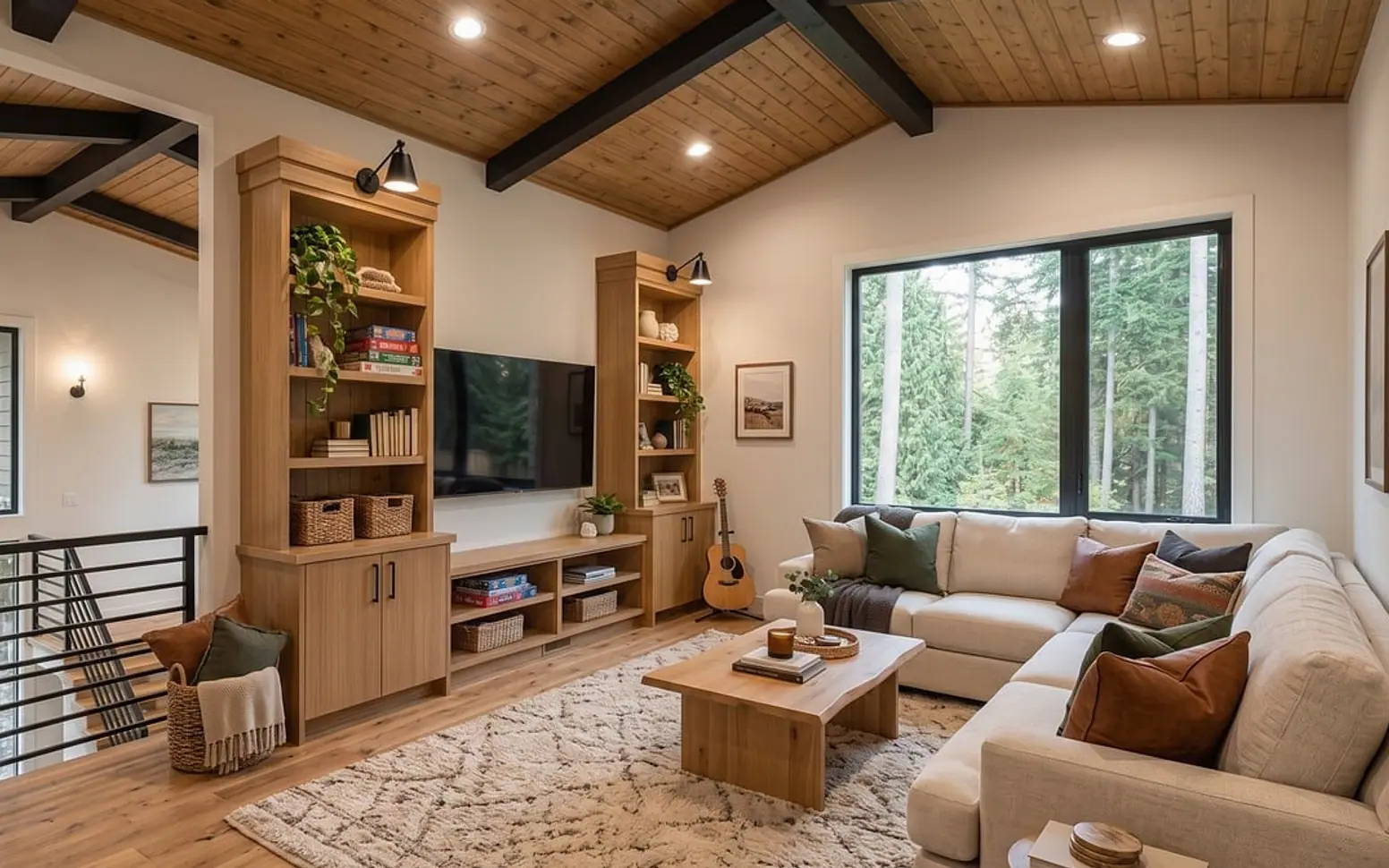
Ai generated, living room and sectional sofa

The invitation goes out on Tuesday, the replies roll in by Wednesday, and suddenly eight people plan to squeeze into a one-bedroom unit on the fourteenth floor to watch the game. A small space does not rule out a good watch party. It just rewards a host who thinks a few steps ahead. What follows is a countdown, from a couple of days out to the moment the last guest heads for the elevator.

Two days before: measure the room, not the guest list

Walk into your living room and count real seats: couch cushions, dining chairs that can be turned around, a sturdy ottoman, floor cushions for anyone happy to sit low. That number, plus two or three people standing near the kitchen, is your comfortable limit. If the list is longer, it's better to say so now than to discover it when the doorway is blocked.

Then look at the screen from every seat. In a narrow room, the best setup is often the simplest one: the TV on the wall that faces the window, so daylight from an afternoon start doesn't wash out the picture, and seats arranged in a loose curve rather than a straight line. If a few guests will end up at an angle, a little tilt on the TV or a slight change of height helps more than you'd expect. A laptop on the kitchen counter showing the same broadcast is a handy second screen for whoever is refilling the chips.

The day before: plan the sound around your neighbours

Condo and apartment walls carry more than most of us think, especially low frequencies. A subwoofer that feels thrilling in the room can rattle the unit next door. A few ways to keep the volume friendly:

  • Turn the bass down, not the dialogue. Many TVs and soundbars have a voice or dialogue mode that keeps the commentary clear at a lower overall volume.
  • Move the speaker away from shared walls. A soundbar pushed against the wall your neighbours share sends sound straight through it.
  • Soften the room. A rug, curtains and a few cushions absorb echo, so the room feels lively without everyone shouting over the TV.
  • Know your building's quiet hours. Most condo corporations and rental buildings have them, and a late game in overtime can run past them. Check yours.

A short note to the neighbours closest to you goes a long way: a date, a rough end time and a phone number in case it gets too loud. Some hosts slip a small treat under the door with it. It costs very little and buys a lot of patience.

The morning of: get the broadcast running early

Nothing deflates a room faster than a host scrolling through menus while the anthem plays. Do a full test run several hours ahead, on the same device and the same channel you'll use for the game. Confirm which broadcaster has it, since national and regional rights mean the channel can change from one week to the next, and sign in to any apps so no one gets locked out by a password prompt mid-period.

Whether the game reaches your screen through a cable box, a streaming stick or an iptv canada service on the TV's own apps, the routine is the same: open the channel, let it play for a few minutes, and check that the picture holds steady while someone else in the unit is using the Wi-Fi. If your router sits in a closet at the other end of the apartment, a wired connection to the TV or a router moved closer to the living room can make the stream noticeably more stable. Write the channel and the input on a sticky note beside the remote, so anyone can fix it if it switches off.

Two hours before: food that suits a tight kitchen

Small kitchens punish ambitious menus. Pick food that can be prepared in advance and served without a stove:

  • A slow cooker of chili or pulled pork, kept warm on the counter.
  • A tray of sandwiches or wraps cut into halves, so guests can eat with one hand.
  • Bowls of popcorn, pretzels and veggies with dip spread around the room rather than all on one table.
  • A cooler or a bucket of ice on the balcony or by the door for drinks, which keeps people out of the fridge.

Put out more garbage and recycling bags than you think you'll need, and set them somewhere obvious. In a condo, the trip to the garbage chute is part of the evening.

At puck drop: a few house rules

House rules sound formal, but in a small room they keep everyone comfortable. Pick three or four and mention them casually when people arrive:

  1. The best seats rotate at each intermission.
  2. Cheering is welcome; banging on walls and floors is not.
  3. Shoes come off at the door, and coats go on the bed.
  4. Whoever touches the remote is responsible for fixing whatever they change.

Some groups like a friendly prediction game, such as guessing the final score or the first goal scorer on a whiteboard, with bragging rights as the prize. If anyone wants to put money on a game, that is a personal choice for adults only, and the rules for betting differ by province, so check what applies where you live and keep it within what you can comfortably afford.

After the final horn

Hold the music back until people are on their way out, and encourage guests to keep the hallway chatter low on the way to the elevator. Open a window, run the dishwasher in the morning instead of at midnight, and send a quick thanks to the neighbours who put up with the noise. If the night went well, you'll know by the replies the next time you send an invitation.

Running order of play

Issue 6October 20269 entries
  1. HOB

    Ship, Captain and Crew: Rules for the Five-Dice Game

    Five dice, three throws and a strict order: first the ship, then the captain, then the crew. Here is how a turn works, how cargo is scored and when rerolling it is worth the risk.

    Hobbies

    5′ Entry73
  2. GAM

    Live Casino Game Shows: How Studio Wheels and Bonus Rounds Work

    A presenter, a studio set and a giant wheel: live game shows dress casino betting up as television. What happens in a round, where the randomness comes from and why each bet spot pays differently.

    Gambling

    4′ Entry70
  3. GAM

    Craps Table Layout and Terms: A Map of the Felt

    A craps table looks crowded because half of it is printed twice. Zone by zone, here is what each part of the felt is for, who runs the game and what the calls at the rail mean.

    Gambling

    4′ Entry69
  4. GAM

    The Field Bet in Craps: Payouts, Odds and the Real Edge

    Seven winning totals against four losing ones sounds like a bargain. Counted across all 36 rolls, the field tells a different story. Payouts, the edge and how it compares with other craps bets.

    Gambling

    4′ Entry68
  5. GAM

    The Craps Odds Bet Explained: True-Odds Payouts Behind the Line

    Once a point is set, craps lets you add a bet behind the line that pays at true odds. How taking and laying odds work, what each point pays and why the combined edge drops.

    Gambling

    4′ Entry67
  6. GAM

    Two-Dice Probability Chart: Every Total from 2 to 12

    Two dice give 36 equally likely results, and 7 is the most common total. The full chart, the difference between probability and odds, and where the numbers matter in board games and craps.

    Gambling

    3′ Entry66
  7. HOB

    How to Play Liar's Dice: Bids, Challenges and Simple Odds

    Five dice, a cup and a straight face: Liar's Dice is a bluffing game where every bid has to top the last. The rules, the wild-ones variant and a quick counting trick for judging bids.

    Hobbies

    4′ Entry65
  8. HOB

    How to Play Bunco: Tables, Rounds and Scoring

    Bunco is the dice game for a crowd: three dice per table, six rounds, a bell and plenty of noise. Here is how scoring works, how a round ends and who moves where afterwards.

    Hobbies

    4′ Entry64
  9. HOB

    Farkle Rules and Scoring: How the Six-Dice Game Works

    Farkle needs six dice, a pencil and the nerve to stop rolling at the right moment. Here are the turn rules, a common scoring table and the real chance of a farkle with each number of dice.

    Hobbies

    4′ Entry63

Two shelves, four themes

Four kinds of reading you will find here

The journal covers games of skill and chance on one side and everyday money and habits on the other.

  • Table and tile games

    Step-by-step rules for dominoes, gin rummy, poker variants and Domino Qiu Qiu, with scoring tables you can keep beside the board.

  • Casino maths, no hype

    House edge, return figures and random number generators explained from the rules up, never as a route to profit.

  • Money habits

    Budget splits, everyday money traps and the risks of borrowing, written as general information rather than personal advice.

  • Goals and routines

    Action plans, habit stacking and motivation pieces that favour small, repeatable steps over grand speeches.

Between two articles

Why a games journal also writes about budgets

People sometimes find it odd that an article on gin rummy sits next to one on the 50/30/20 rule. To us they belong together. Every game, whether it is played for points or for money, goes better when you know the rules, set a limit and stop at a sensible time.

So the journal keeps two shelves. One explains how games work, honestly and without tips. The other covers the everyday habits that make sure leisure stays leisure.

Amabel, on behalf of the Trickoteka writers

Section league

#ShelvesEntriesReading minutesMost recentLatest five
1 ENTEntertainment 67 165
2 GAMGambling 62 144
3 HOBHobbies 61 140
4 BLOBlog 57 123
5 LIFLifestyle 57 124

Price into percentage

Turn a betting price into a probability

Prices can be written three ways, and each one hides the same number: the chance the bookmaker implies. Type a decimal price to see its fractional and American versions and the probability behind it.

Fractional: –

American: –

Implied probability: –

Implied probability shows what a price suggests, not the true chance of an event. Add up the implied probabilities of every outcome in a market and the total usually comes to more than 100 percent; that excess is the bookmaker's margin. This tool converts formats only and says nothing about who will win.

The line-up board2–3

Before any game with real money

Games of chance are for adults aged 18 and over. They cost money over time, so treat them as a night out, not a plan.

  • Choose a spending cap you would not miss
  • Set a timer and leave when it rings
  • Never borrow or dip into bill money to play
  • Pause after a big win or loss
  • Confirm that playing is legal where you live

Warning signs and where to find support