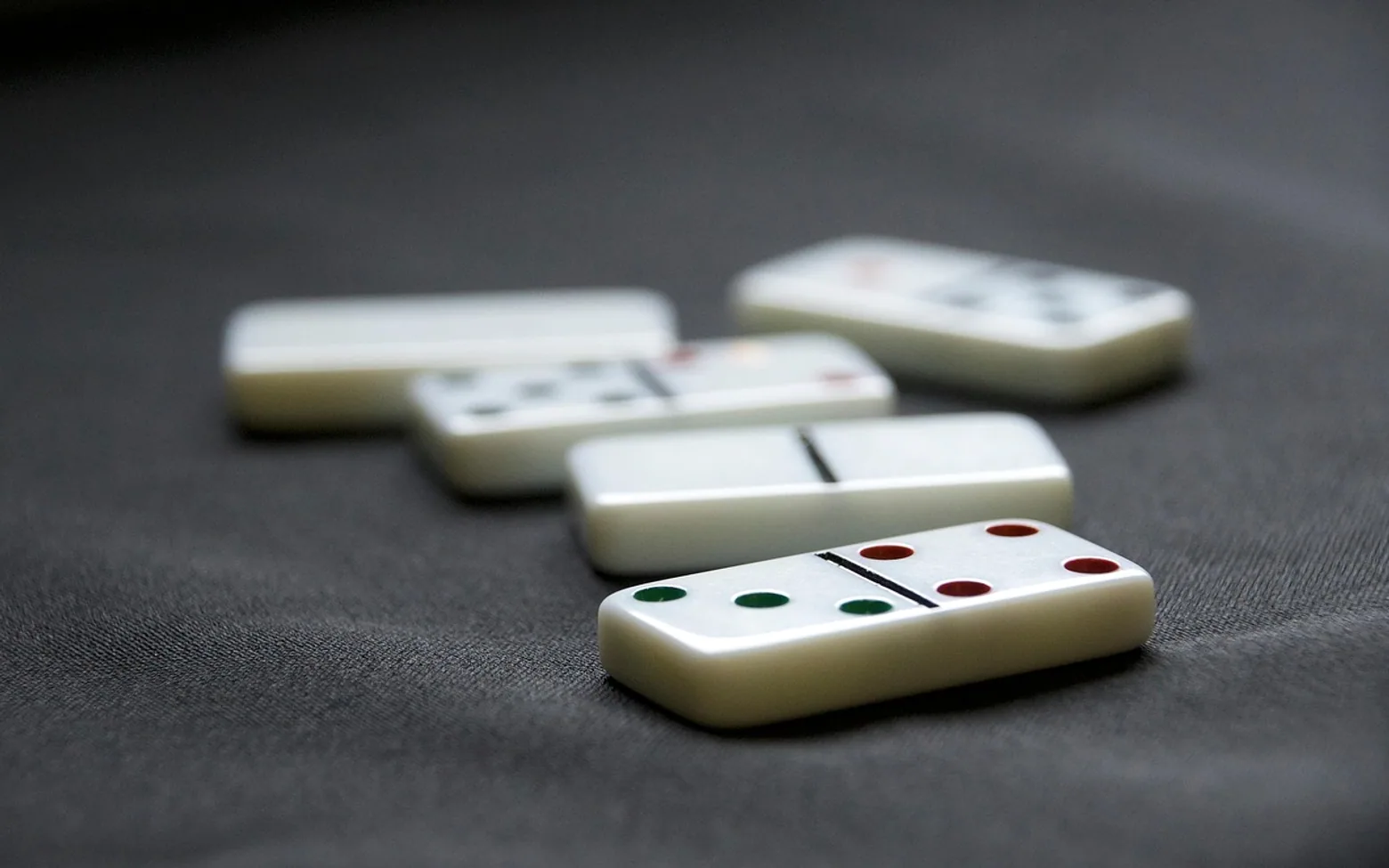
The classic draw game in dominoes runs out of room once more than four people want to play: there are only 28 tiles and two open ends to fight over. Mexican Train solves that by giving every player a line of their own. It uses a larger set, keeps everyone busy on every turn and comfortably seats a whole family. Expect plenty of small house-rule differences between groups; what follows is the version most tables recognise.
Equipment and the deal
You need a double-twelve set of 91 tiles, a central hub (a plastic station with slots, though a clear space on the table works), a marker for each player, often a small toy train, and paper for the scores. Two to eight people can play.
Turn every tile face down and shuffle. The number each player draws depends on the size of the table, and a common guide looks like this:
| Players | Tiles each |
|---|---|
| 2 to 4 | 15 |
| 5 to 6 | 12 |
| 7 to 8 | 10 |
The leftover tiles form the boneyard. Many players stand their tiles on edge so the pips stay hidden.
The engine and the thirteen rounds
Each round starts from a double placed in the hub, called the engine. Round one uses the double-twelve, round two the double-eleven, and so on down to the double-blank in round thirteen. Whoever holds the engine places it in the hub. If nobody has it, players draw one tile each in turn until it appears.
Personal trains and the Mexican train
Every player owns one personal train, a line of tiles that starts at the hub and runs towards their seat. Its first tile must match the engine: in round one, a tile with a twelve on one end. After that, each new tile matches the open end of the line, just as in ordinary dominoes.
There is also one shared line, the Mexican train. It also starts from the hub, anyone can begin it with a matching tile, and once it exists anyone may add to it on their turn.
Playing a turn
- Play one tile. Add a matching tile to your own train, to the Mexican train or to any other player's train that is marked as open.
- Draw if you are stuck. If you have no legal play, draw one tile from the boneyard. If it fits, you may play it straight away.
- Mark your train. If you still cannot play, place your marker on the end of your personal train. It is now open to everyone.
- Clear the marker. The next time you play a tile on your own train, remove the marker and it closes again.
On the very first turn of a round, many groups let each player lay as many tiles as they can on their own train, so that everyone gets a line started.
Playing a double
Doubles are where the game turns tactical. When you play a double, you must play again. The double then has to be satisfied, which means covered by a matching tile, before play can continue anywhere else. If you cannot cover it yourself, even after drawing, you mark your train and the duty passes to the next player, who must cover it or draw, and so on around the table. Getting stuck on someone else's double is a common way to end up with an open train.
Ending a round and scoring
The round ends when one player lays their last tile, or when the boneyard is empty and nobody can play. Every other player adds up the pips on the tiles still in their hand, and that total goes on the score sheet. The player who went out scores zero. After the round of the double-blank, the lowest total over all thirteen rounds wins.
Two house rules come up often enough to settle before the first round: some tables count the double-blank as 50 points when it is left in a hand, and some require a player with one tile left to announce it by tapping the table.
Tips for a first game
- Plan your own train early. Laying out a line in your hand before you play saves tiles for later.
- Keep high tiles moving. Late in the round, a stranded double-twelve is expensive.
- Use the Mexican train to dump awkward tiles you cannot fit into your own line.
- Watch the open markers. A neighbour's open train is a gift when you are short of moves.
Where it fits on a games shelf
Mexican Train grows directly out of the draw game with a double-six set, so anyone who knows the matching rule picks it up within a round. It shares the easy, chatty pace of a Bunco night with rotating tables, and it suits holiday gatherings in the same way yut nori and other traditional Korean games do at the Lunar New Year: a board in the middle, several generations around it and nobody left waiting for long. For evenings when only two people are at the table, classic card games for a pair of players make a better fit.
Editor’s picks
 HobbiesFarkle Rules and Scoring: How the Six-Dice Game Works4 min
 GamblingThe Craps Odds Bet Explained: True-Odds Payouts Behind the Line4 min
 GamblingWhat Is the House Edge? The Built-In Margin, Explained4 min
 BlogWHAT I ACTUALLY DO FOR A LIVING | BUILT 11 INCOME STREAMS BY AGE 27 | Side Hustles & Passive Income2 min