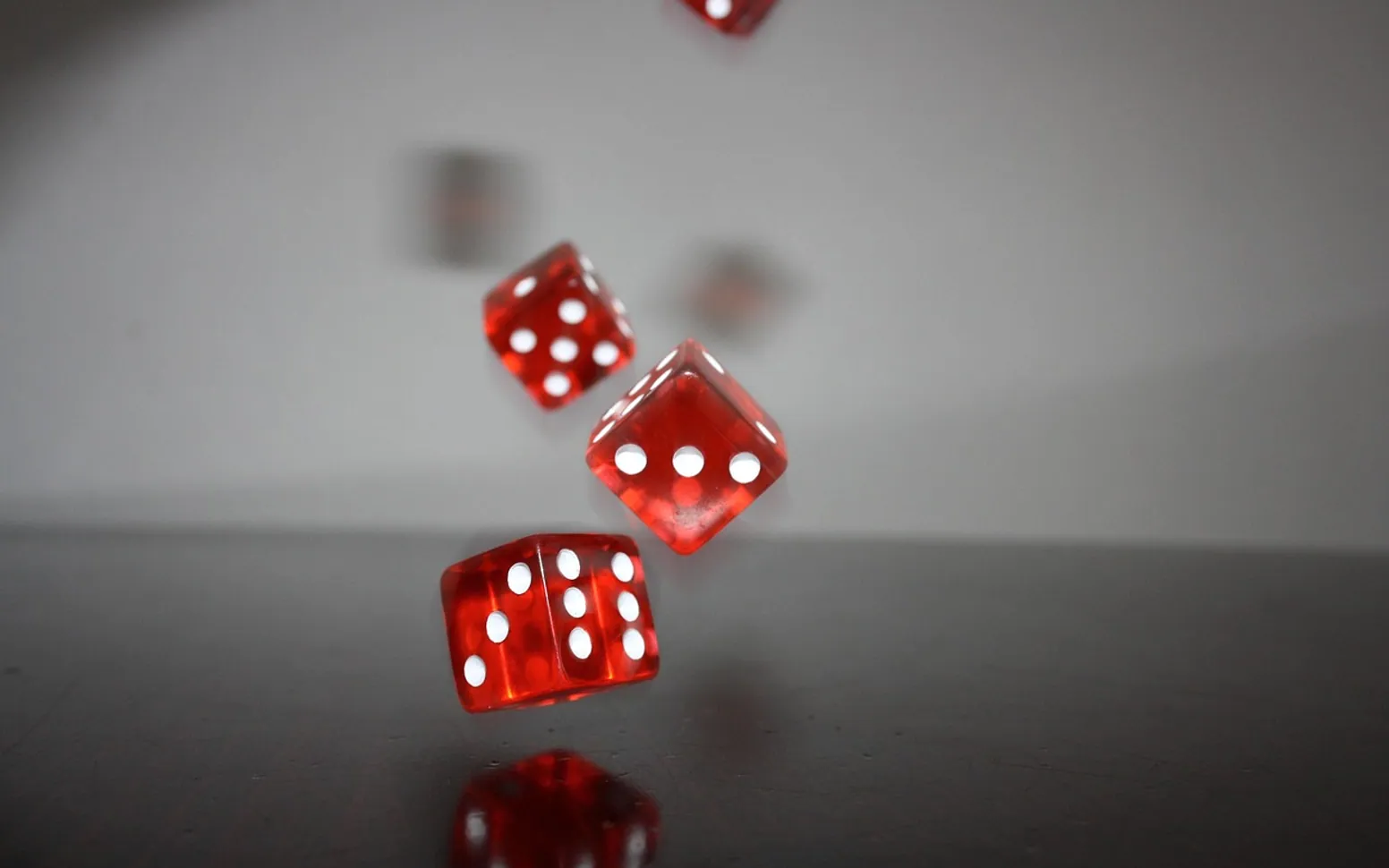
Roll two ordinary dice and there are 36 equally likely outcomes. The total of 7 turns up more often than any other, in 6 of those 36 outcomes, or one roll in six. Totals of 2 and 12 are the rarest, at 1 in 36 each, and everything else falls in between in a neat triangle shape. This guide lays out the full chart and shows how to use it at a board-game table, in home dice games and around a craps layout.
Why there are 36 outcomes
Each die has six faces. Treat the dice as two separate objects, say a red one and a white one, and every face of the red die can pair with every face of the white die: 6 × 6 = 36 combinations. A red 3 with a white 4 and a red 4 with a white 3 are different outcomes, even though both make 7. Overlooking that distinction is the most frequent slip in dice arithmetic.
The probability chart
| Total | Combinations | Ways | Probability | Approx. % |
|---|---|---|---|---|
| 2 | 1+1 | 1 | 1/36 | 2.78% |
| 3 | 1+2, 2+1 | 2 | 2/36 | 5.56% |
| 4 | 1+3, 2+2, 3+1 | 3 | 3/36 | 8.33% |
| 5 | 1+4, 2+3, 3+2, 4+1 | 4 | 4/36 | 11.11% |
| 6 | 1+5, 2+4, 3+3, 4+2, 5+1 | 5 | 5/36 | 13.89% |
| 7 | 1+6, 2+5, 3+4, 4+3, 5+2, 6+1 | 6 | 6/36 | 16.67% |
| 8 | 2+6, 3+5, 4+4, 5+3, 6+2 | 5 | 5/36 | 13.89% |
| 9 | 3+6, 4+5, 5+4, 6+3 | 4 | 4/36 | 11.11% |
| 10 | 4+6, 5+5, 6+4 | 3 | 3/36 | 8.33% |
| 11 | 5+6, 6+5 | 2 | 2/36 | 5.56% |
| 12 | 6+6 | 1 | 1/36 | 2.78% |
The ways column always adds up to 36. Totals the same distance from 7 share a probability: 6 and 8, 5 and 9, 4 and 10, and so on out to 2 and 12.
Probability versus odds
Probability compares the ways to win with all possible outcomes. Odds compare the ways to win with the ways to lose. For a 7, the probability is 6 in 36 (1 in 6), while the odds against it are 30 to 6, which reduces to 5 to 1. Games quote payouts in odds form, so converting between the two is a handy habit:
- Probability to odds against: losing ways set against winning ways.
- Odds against to probability: winning ways divided by the sum of winning and losing ways.
Useful results beyond single totals
- Any double: six outcomes (1+1 through 6+6), so 1 in 6.
- At least one six: 11 outcomes, or 11/36, about 30.6%. It is not 2 in 6, because that would count the double six twice.
- A total of 7 or 11: 8 outcomes, 2 in 9.
- A total of 2, 3 or 12: 4 outcomes, 1 in 9.
- A 6 before a 7, ignoring every other total: 5 ways against 6, so 5 in 11.
Where the chart shows up
Board games
Plenty of trading and settlement board games hand out resources on two-dice totals. Knowing that a 6 or an 8 arrives five times as often as a 2 or a 12 explains why spots on those numbers are so prized.
Craps
Every craps bet is priced from this chart. The pass line's first roll wins on 7 or 11 and loses on 2, 3 or 12, and the later "point" phase is a race between one number and the 7. The craps odds bet is the one wager on the layout paid at exactly these true odds, while the field bet looks generous until its losing totals are counted.
Home dice games
Games played with more dice apply the same counting method on a larger scale. The risk table in the guide to Farkle rules and scoring comes from exactly this kind of enumeration.
Myths the chart puts to rest
- "A 7 is due." Dice have no memory. After ten rolls without a 7, the next roll still carries a 1-in-6 chance.
- Hot and cold dice. Streaks appear in every random sequence; they say nothing about the next outcome.
- Controlling the throw. Casino rules ask shooters to bounce both dice off a textured back wall, which is there to randomise each throw. Treat any claim of steering the result with suspicion.
At a casino table, the chart explains why every bet except the odds carries a built-in margin, a subject covered in the explainer on what the house edge is. Knowing the numbers helps you understand a game; it is no route to beating it. Gambling is for adults only, and any money staked should be spare cash set aside for entertainment, within the rules that apply where you live.
Editor’s picks
 HobbiesFarkle Rules and Scoring: How the Six-Dice Game Works4 min
 GamblingThe Craps Odds Bet Explained: True-Odds Payouts Behind the Line4 min
 GamblingWhat Is the House Edge? The Built-In Margin, Explained4 min
 BlogWHAT I ACTUALLY DO FOR A LIVING | BUILT 11 INCOME STREAMS BY AGE 27 | Side Hustles & Passive Income2 min
Subjects by size
Two-dice odds checker
Tap one or more totals, or load a craps bet, and the board lights up the matching rolls out of all 36.
True odds are what a bet would pay if the table took no margin. Casino payouts sit below them on every craps bet except the odds bet, so this board shows the arithmetic of the game, not a way to beat it. Adults only, with spare money and the local rules in mind.