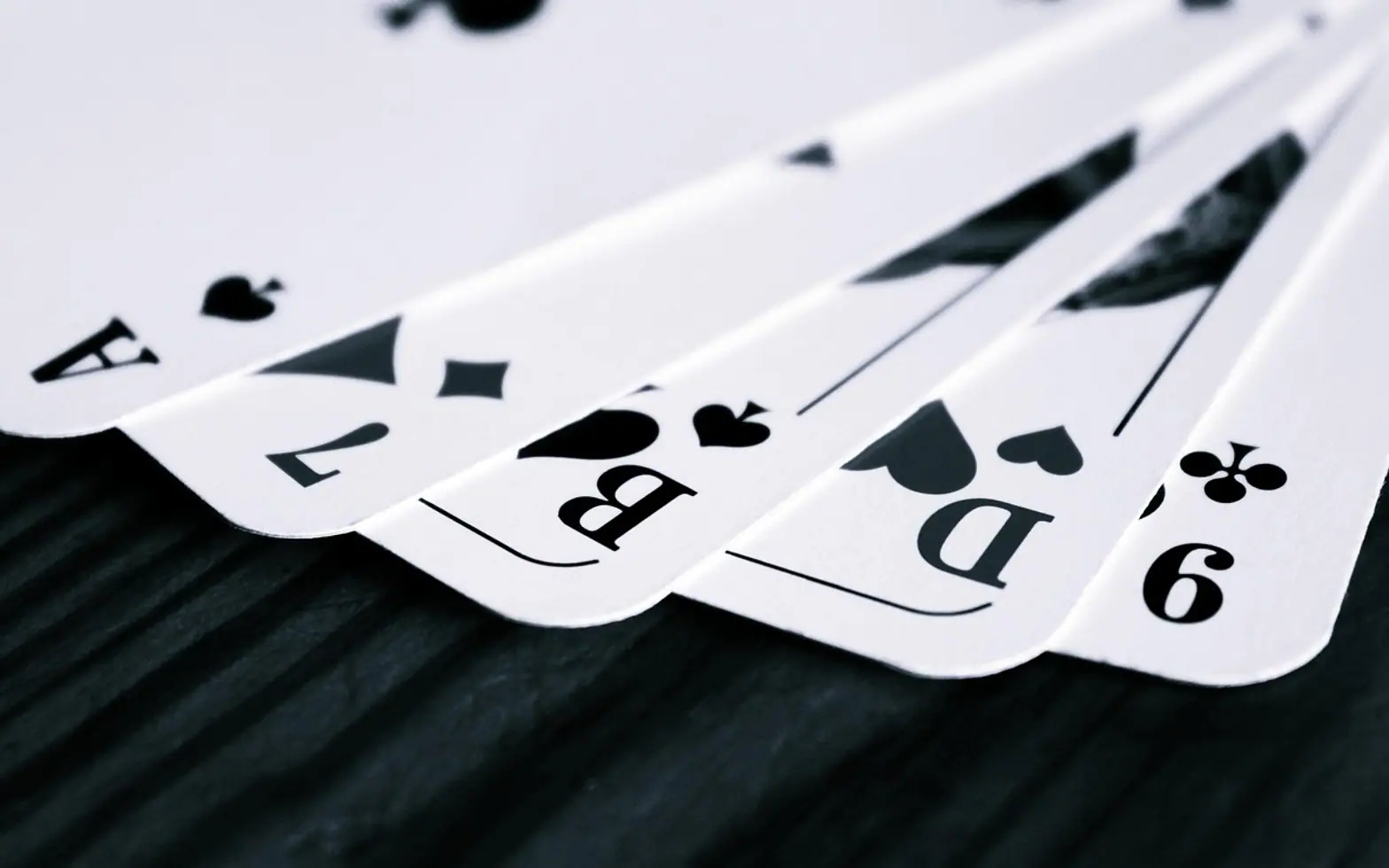
The power has gone out, the phones are charging, and there are two of you at the kitchen table with a single deck of cards found in a drawer. Plenty of the best-known card games quietly assume four players, which leaves a pair shuffling and wondering what to deal. Yet some of the oldest games in the deck were built for exactly two people. Here are seven that need nothing more than a standard 52-card pack, sorted roughly from the most thoughtful to the most frantic.
The seven at a glance
| Game | Style | Typical length | Extra kit |
|---|---|---|---|
| Gin rummy | Melding and counting | 30 to 60 minutes | Pencil and paper |
| Cribbage | Counting and pegging | About 30 minutes | Cribbage board or paper |
| Casino | Capturing cards | 20 to 40 minutes | Pencil and paper |
| German Whist | Trick-taking | About 15 minutes a hand | None |
| Speed | Real-time race | A few minutes | None |
| Crazy Eights | Shedding cards | 10 to 20 minutes | None |
| War | Pure luck | Open-ended | None |
1. Gin rummy
Each player gets ten cards and tries to arrange them into sets of the same rank and runs in one suit, drawing and discarding one card a turn. When the unmatched cards total ten points or less, you may knock and end the hand. It rewards memory: every discard tells you something about your opponent's hand. The full deal, knocking rules and scoring table are in our gin rummy rules and scoring guide.
2. Cribbage
Cribbage has kept pairs of players busy for centuries. Each player is dealt six cards and discards two into a spare hand called the crib, which belongs to the dealer. Players then lay cards alternately, calling out the running total and scoring for hitting fifteen, for pairs and runs, and for reaching exactly 31. Afterwards each hand is counted for combinations that add up to fifteen, pairs, runs and flushes. Points are marked by moving pegs along a board, and the first to 121 wins. It takes a couple of games to learn the counting, and then it becomes a habit.
3. Casino
Casino is an old fishing game, nothing to do with gambling despite the name. Four cards go to each player and four face up on the table. On your turn you play one card to capture table cards of the same rank, or cards whose values add up to the card you played. You can also build combinations to capture on a later turn. When the hands run out, four more are dealt to each player, without new table cards, until the deck is gone.
Scoring after each deal is the classic part:
- Most cards captured: 3 points
- Most spades: 1 point
- The ten of diamonds (big casino): 2 points
- The two of spades (little casino): 1 point
- Each ace: 1 point
- Each sweep, clearing the table in one capture: 1 point, in many versions
Games are commonly played to 21.
4. German Whist
German Whist turns a four-player family game into a duel. Each player receives thirteen cards, the rest form a face-down stock, and the top card is turned face up; its suit is trumps. In the first half, the winner of each trick takes the face-up card and the loser takes the next hidden card, then a new card is turned. Once the stock is empty, the last thirteen tricks are played out, and only these count. The player who takes more of them wins the hand. The first half becomes a quiet contest over which cards are worth fighting for.
5. Speed
Speed has no turns at all. Each player takes a draw pile of twenty cards and holds five in hand. Two cards are placed face up in the centre, with two small side stacks of five cards beside them for when play stalls. On "go", both players play as fast as they can onto either centre pile, using any card one rank higher or lower than its top card, regardless of suit. When neither can move, each flips a card from the side stacks onto the centre piles. The first to get rid of every card wins. It is loud, quick and very good at settling who does the dishes.
6. Crazy Eights
With two players, deal seven cards each and turn one card up to start the discard pile. On your turn, play a card that matches the top card by suit or rank. Eights are wild: play one at any time and name the next suit. If you cannot play, draw from the stock until you can, or until the stock runs out. The first player to empty their hand wins the round. Many families score the cards left in the loser's hand, with eights worth the most.
7. War
Split the deck evenly, face down. Both players flip their top card, and the higher card takes both. Equal cards mean war: each player lays three cards face down and one face up, and the higher face-up card takes the whole pile. The game ends when one player holds every card, or when everyone agrees it is time for bed. There are no decisions in War, which makes it a fine first game for young children and a poor one for anyone else.
Picking the right one
- For a long, quiet evening: cribbage or gin rummy.
- For learning to count cards in your head: Casino or German Whist.
- For a burst of energy: Speed.
- For mixed ages: Crazy Eights, then War for the youngest player.
If the deck goes missing, the same pair can switch to tiles. The two-player draw game in dominoes plays much like a card game with a matching rule, and a game of Yahtzee needs only five dice and a scorecard.
Editor’s picks
 HobbiesFarkle Rules and Scoring: How the Six-Dice Game Works4 min
 GamblingThe Craps Odds Bet Explained: True-Odds Payouts Behind the Line4 min
 GamblingWhat Is the House Edge? The Built-In Margin, Explained4 min
 BlogWHAT I ACTUALLY DO FOR A LIVING | BUILT 11 INCOME STREAMS BY AGE 27 | Side Hustles & Passive Income2 min