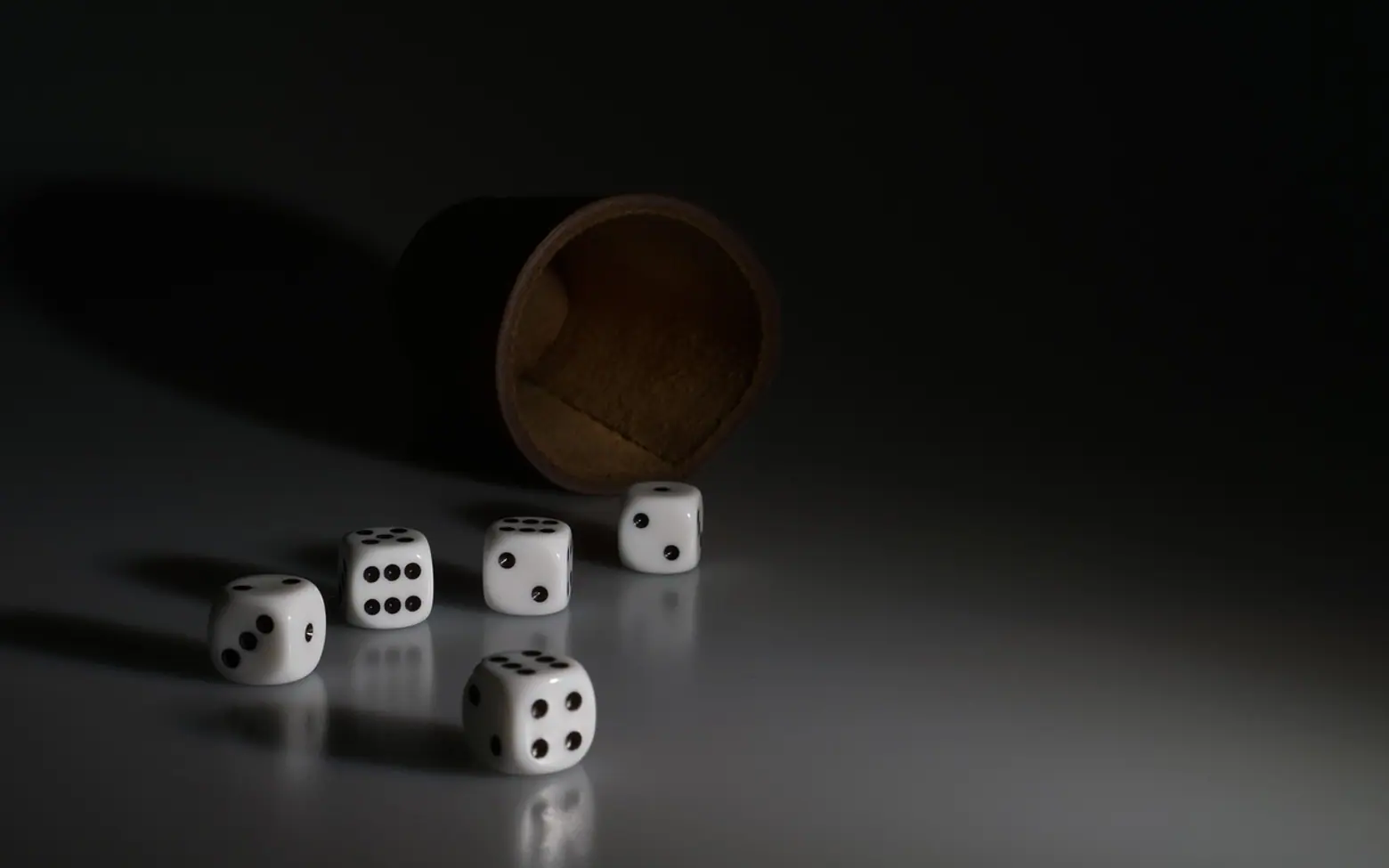
Yahtzee is a dice game for one or more players built around five dice and a scorecard with thirteen boxes. On each turn you roll up to three times, keeping any dice you like between rolls, and then you must write a score in one empty box. After thirteen turns every box is filled, the scores are added up, and the highest total wins. The skill lies in deciding which dice to keep and, just as often, which box to sacrifice when a turn goes badly.
What you need
- Five standard six-sided dice and a cup to shake them in
- One scorecard per player (a printed sheet or a hand-drawn grid works fine)
- A pencil, since crossing out happens more than people expect
There is no upper limit on players, but every extra person adds a turn to each round. Groups of two to five keep the game moving at a pleasant pace.
How a turn works
- First roll. Throw all five dice.
- Keep or reroll. Set aside any dice you want to keep and roll the rest. You may change your mind and pick up kept dice again before the next throw.
- Third roll. Do the same once more if you wish. You can stop after the first or second roll if the dice already fit a box.
- Score. Choose one empty box on your card and write in what the dice are worth there. If they fit nowhere useful, you still have to fill a box, even if it means entering a zero.
That last rule shapes the whole game. Every box can be used only once, so a weak turn late in the game often means giving up a box you were saving.
The scorecard, box by box
Upper section
The upper section has six boxes, one for each face: Aces (ones), Twos, Threes, Fours, Fives and Sixes. In each box you add up only the dice showing that number. Three 4s entered in the Fours box score 12; the other two dice are ignored.
If the six upper boxes add up to 63 or more, you collect a 35-point bonus. The number 63 is not random: it is what you get by scoring three of each face (3 + 6 + 9 + 12 + 15 + 18). Falling short in Aces or Twos can be covered by a fourth Five or Six elsewhere.
Lower section
| Box | What the dice must show | Score |
|---|---|---|
| Three of a kind | At least three dice the same | Total of all five dice |
| Four of a kind | At least four dice the same | Total of all five dice |
| Full house | Three of one number and two of another | 25 |
| Small straight | Four numbers in sequence, such as 2-3-4-5 | 30 |
| Large straight | Five numbers in sequence, 1-2-3-4-5 or 2-3-4-5-6 | 40 |
| Yahtzee | All five dice the same | 50 |
| Chance | Anything at all | Total of all five dice |
Chance is the safety net. It accepts any roll, which makes it valuable late in the game, when a turn has gone wrong and the only other option is a zero.
Extra Yahtzees and the joker rule
Rolling five of a kind a second time is rare, and the standard rules reward it. If you have already scored 50 in the Yahtzee box, each further Yahtzee earns a 100-point bonus, usually marked with a check in a separate bonus row. If you entered a zero in the Yahtzee box earlier, later Yahtzees earn no bonus.
You still have to fill a box on that turn, and the joker rule tells you where:
- If the matching upper box is empty (Fours for five 4s, say), you must score it there.
- If that upper box is already used, you may fill any open lower box. A Yahtzee used this way counts as a full house, small straight or large straight at their full value.
- If every lower box is filled too, you must enter a zero in an open upper box.
Some families play without the joker rule or with their own version of it. As with most home games, agree before the first throw.
Keeping dice: a few patterns that help
Yahtzee has no single correct strategy, but a few habits keep scores steady:
- Chase the upper bonus early. Three or more of a high number belongs in the upper section during the first half of the game. The 35 points are worth more than most single lower boxes.
- Do not burn Chance too soon. Using it on turn two for a mediocre total leaves no cushion for later.
- Straights reward open-ended dice. Holding 3-4-5 leaves more ways to finish a straight than holding 1-2-3, because both a 2 and a 6 help.
- Know your dump box. When a turn collapses, a zero in Aces usually hurts less than a zero in the Yahtzee or large straight box, though it can cost the upper bonus.
The odds behind those choices follow the same counting method shown in the chart of every two-dice total, only with more dice in play.
Yahtzee beside its relatives
Yahtzee belongs to a large family of roll-and-keep games. Farkle's bank-or-bust scoring uses six dice and lets you keep rolling as long as something scores, while the five-dice race to load a ship, captain and crew strips the idea down to a single target per turn. Both work well as a warm-up before a longer Yahtzee game.
Because a full game takes about half an hour for a small group and needs only a tabletop, it suits a crowded living room too. Seating, snacks and noise in tight quarters are covered in a guide to hosting a game night in a small condo or apartment.
Yahtzee questions
Can I play Yahtzee alone?
Yes. Solo play is simply a game against your own best score. Many players keep a running record and try to beat it.
Does a Yahtzee count as a full house?
Only under the joker rule, and only once the Yahtzee box and the matching upper box are already filled. Otherwise five of a kind is not three of one number plus two of another.
Can I score a box before using all three rolls?
Yes. Stopping after one or two rolls is common, especially when the first throw already shows a straight or a full house.
What happens when two players tie?
The official rules do not settle it. Most groups either share the win or play one extra turn each, scoring the five dice as Chance.
Editor’s picks
 HobbiesFarkle Rules and Scoring: How the Six-Dice Game Works4 min
 GamblingThe Craps Odds Bet Explained: True-Odds Payouts Behind the Line4 min
 GamblingWhat Is the House Edge? The Built-In Margin, Explained4 min
 BlogWHAT I ACTUALLY DO FOR A LIVING | BUILT 11 INCOME STREAMS BY AGE 27 | Side Hustles & Passive Income2 min