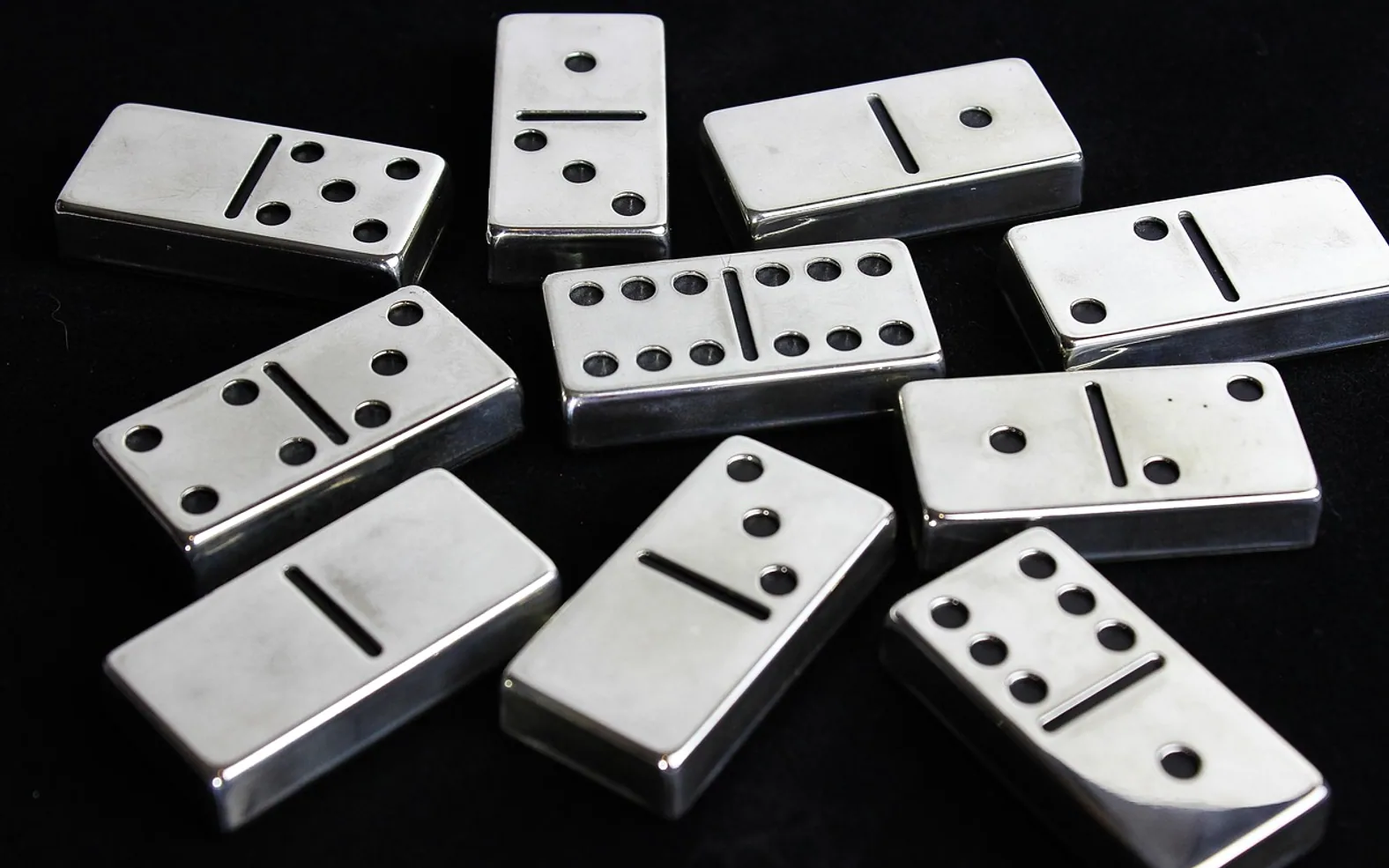
Dominoes is one of those games that seems to belong to everyone. It is played on kitchen tables, café terraces and park benches across the world, often with house rules handed down through families. Underneath all the local twists sits a simple core game. Learn that, and you can sit down at almost any table and follow what is going on. This guide covers the draw game, the version most people mean when they say "let's play dominoes".
What is in the box
The standard set is the double-six set of 28 tiles. Each tile is split into two ends, and each end shows from zero to six pips. Every possible pairing appears exactly once, from the blank-blank to the six-six. Tiles with the same number on both ends are called doubles, and there are seven of them. Larger sets, such as double-nine or double-twelve, exist for bigger groups, but the double-six set is the one to learn on.
Three words come up constantly at the table:
- Pips: the dots on each end of a tile.
- Boneyard: the face-down pile of tiles left after the deal.
- Line of play: the chain of tiles growing across the table.
Setting up
- Turn all tiles face down and shuffle them with flat hands. This is often called washing the tiles.
- Each player draws a hand. With two players, each takes seven tiles. With three or four players, each usually takes five, though many tables use seven for three players as well.
- Stand your tiles on their edges so only you can see the faces. The rest stay face down as the boneyard.
- Decide who starts. A common rule is that the player holding the highest double sets it down first; another is that everyone draws one tile and the heaviest goes first.
Playing a turn
Play moves clockwise. On your turn you place one tile so that one of its ends matches the number on an open end of the line. A three-five can be placed against an open five, with the three now facing outwards as the new open end. Doubles are traditionally laid crosswise, which makes them easy to spot but does not change the matching rule in the basic game.
If you cannot match either open end, you draw from the boneyard until you pick up a tile that fits, then play it. When the boneyard is down to its last tiles, house rules differ: some tables leave two tiles that may never be drawn, others let players draw to the end. If the boneyard is empty and you still cannot play, you pass.
Ending a round and scoring
A round ends in one of two ways. Either a player lays their final tile and calls domino, or the game is blocked because no one can play and nothing is left to draw. The table below shows the usual way to score each case.
| How the round ends | Who wins | Points scored |
|---|---|---|
| A player empties their hand | That player | The total pips left in all opponents' hands |
| The game is blocked | The player with the lowest pip total | The difference between their total and each opponent's, or all opponents' pips, depending on house rules |
Games are usually played to an agreed target, such as 100 or 150 points, so a session lasts several rounds. Agree on the target and the blocked-game rule before the first tile goes down; most domino arguments start right there.
The block game and other variations
The block game is the same as the draw game except that nobody draws. If you cannot play, you pass. It is tighter and more tactical, because the tiles you hold are the only tiles you will ever have. Popular scoring variants such as All Fives reward players whenever the open ends add up to a multiple of five, which adds a counting element to every turn. Gambling variants built on domino tiles, such as the Indonesian game covered in our beginner's guide to Domino Qiu Qiu, use the same tiles but entirely different rules.
Simple tips for new players
- Get rid of heavy tiles early. High-pip tiles cost you most if someone else goes out first.
- Keep variety in your hand. Holding several different numbers gives you more ways to match later.
- Watch what others pass on. If a player draws when a four is open, they probably hold no fours.
- Count the numbers. Each number appears on seven tiles in a double-six set. When most of them are on the table, you can predict when an end will lock up.
A game for any evening
Dominoes needs nothing but a flat surface and a set of tiles, and a round takes only a few minutes. It suits two players over coffee as well as a crowded family table. If your group enjoys it, a card game with a similar matching rhythm is a good next step; our guide on how to play gin rummy is a natural partner for a games night.
Editor’s picks
 HobbiesFarkle Rules and Scoring: How the Six-Dice Game Works4 min
 GamblingThe Craps Odds Bet Explained: True-Odds Payouts Behind the Line4 min
 GamblingWhat Is the House Edge? The Built-In Margin, Explained4 min
 BlogWHAT I ACTUALLY DO FOR A LIVING | BUILT 11 INCOME STREAMS BY AGE 27 | Side Hustles & Passive Income2 min