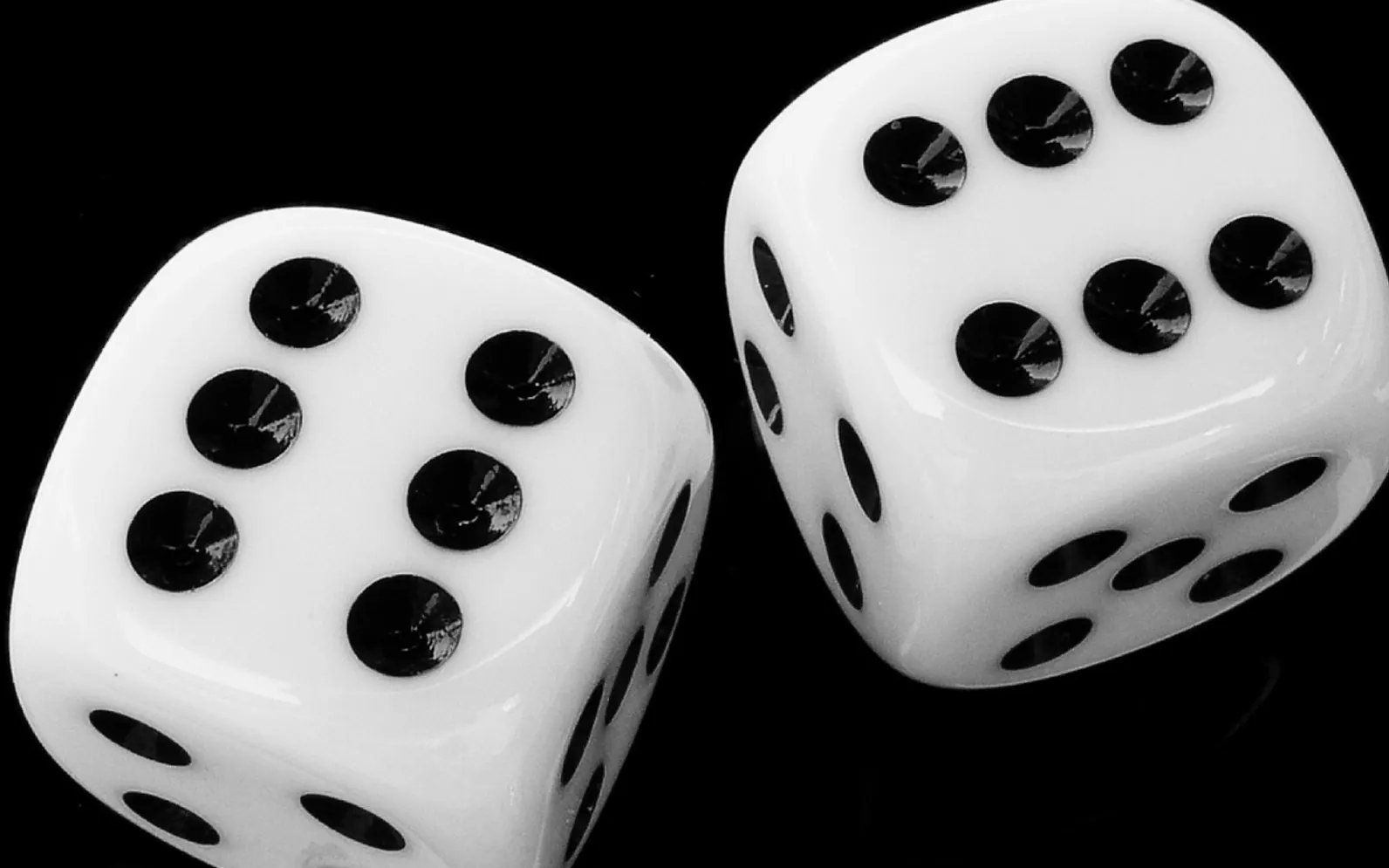
A craps table looks busy because most of it is printed twice. The two ends carry identical, mirrored betting areas so players on either side can reach them, and the middle holds one shared panel of short-lived bets. Once that is clear, the felt breaks down into a handful of zones. This guide walks through each zone, the crew who run the game and the slang heard around the rail.
The table at a glance
A full-size table is a deep, walled tub with a rail around the top for chips. The inner walls at each end are lined with rubber pyramids so the dice bounce unpredictably, and shooters are asked to throw hard enough for both dice to hit the far wall. Players stand around the rail, and the dice travel clockwise from one shooter to the next.
The zones, from the rail inwards
| Zone | What it is for | When it settles |
|---|---|---|
| Pass line | The main bet with the shooter, placed before a come-out roll | When the point repeats or a 7 shows |
| Don't pass bar | The main bet against the shooter | Same rolls, opposite result; a 12 on the come-out is usually a push |
| Come box | A pass-line-style bet started after a point exists | Moves to its own number, then follows the same race |
| Don't come bar | The don't-pass version of the come bet | As above, reversed |
| Field | One-roll bet on 2, 3, 4, 9, 10, 11 and 12 | Next roll |
| Place numbers (4, 5, 6, 8, 9, 10) | Bets that a chosen number arrives before a 7 | When that number or a 7 shows |
| Big 6 and Big 8 | Even-money bets on a 6 or 8 before a 7 | When that number or a 7 shows |
| Centre (proposition) panel | Hardways, any seven, any craps, single-total rolls | Mostly the next roll; hardways until a 7 or the easy way |
The field bet has its own breakdown, and the odds bet, the only wager without a house edge, has no printed box at all: its chips sit behind the line bet.
The Big 6 and Big 8 corner
These pay even money on a number that wins 5 times for every 6 sevens, which works out to an edge of about 9.09 percent. A place bet on the same 6 or 8 normally pays 7 to 6, an edge of about 1.52 percent. The comparison explains why many tables have dropped the Big 6 and Big 8 box altogether.
The centre panel
The stickman looks after these bets. Common examples, with the payouts usually printed:
- Any seven: pays 4 to 1 against true odds of 5 to 1.
- Hard 6 or hard 8: 3+3 or 4+4 before a 7 or the "easy" combination; usually 9 to 1.
- Hard 4 or hard 10: 2+2 or 5+5 on the same terms; usually 7 to 1.
- Any craps: a 2, 3 or 12 on the next roll; usually 7 to 1.
Big payouts against short true odds give these the steepest margins on the felt, roughly 9 to 17 percent for the examples above.
The crew
- Boxman: seated between the two base dealers, supervising chips, payouts and any disputes.
- Stickman: standing opposite the boxman, moving the dice with a hooked stick, calling each result and handling the centre bets.
- Base dealers: one at each end, taking and paying bets on their half of the layout.
- Shooter: the player currently throwing, usually required to have a pass or don't pass bet in action.
Online versions keep the same zones on screen and highlight where each bet can go, which makes them a gentle way to learn the layout before standing at a real rail.
Terms you will hear
| Term | Meaning |
|---|---|
| Come-out roll | The first roll of a new round, before any point is set |
| Point | The 4, 5, 6, 8, 9 or 10 rolled on the come-out, which the shooter now tries to repeat |
| Puck (on/off) | A disc marking the point; "off" means a come-out roll is next |
| Natural | A 7 or 11 on the come-out |
| Craps | A 2, 3 or 12 on the come-out |
| Seven out | A 7 after a point is set; the round ends and the dice move on |
| Yo | The 11, called "yo" or "yo-leven" so it is not misheard as seven |
| Snake eyes / aces | A 2 (1+1) |
| Ace-deuce | A 3 (1+2) |
| Boxcars / midnight | A 12 (6+6) |
| Hard way / easy way | A 4, 6, 8 or 10 rolled as a pair (hard) or any other way (easy) |
| Working / off | Whether a bet is live on the next roll |
| Press | Adding winnings to a bet to make it bigger |
| Colour up | Swapping small chips for larger ones before leaving |
Etiquette that keeps the game smooth
- Lay cash on the felt rather than handing it to a dealer, then wait for chips.
- Keep hands out of the tub while the dice are in the air.
- Throw with one hand and aim for the far wall.
- Many regulars avoid saying "seven" aloud during a shooter's turn. It is pure superstition, but easy to respect.
Every number on the felt traces back to the 36 outcomes of two dice, and every bet apart from the odds leaves a margin for the house. Craps is for adults; settle on a spending limit before buying in and follow the local rules on where and how you may play.
Editor’s picks
 HobbiesFarkle Rules and Scoring: How the Six-Dice Game Works4 min
 GamblingThe Craps Odds Bet Explained: True-Odds Payouts Behind the Line4 min
 GamblingWhat Is the House Edge? The Built-In Margin, Explained4 min
 BlogWHAT I ACTUALLY DO FOR A LIVING | BUILT 11 INCOME STREAMS BY AGE 27 | Side Hustles & Passive Income2 min